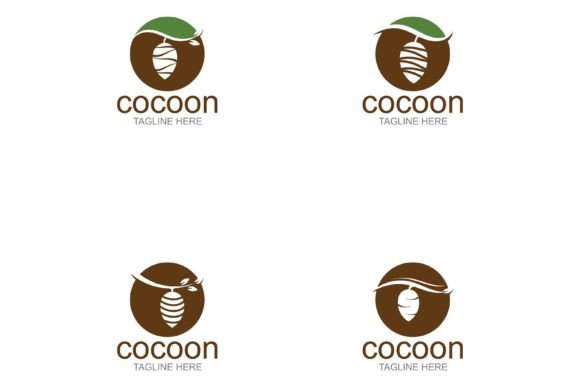
Evaluating the Cocoon Logo Template Vector Icon for Brand Identity Design
In the landscape of modern branding, few concepts resonate as universally as transformation. The Cocoon Logo Template Vector Icon serves as a powerful visual metaphor for growth, protection, and metamorphosis. For designers and business owners alike, selecting the right symbolic language is critical when communicating values such as evolution, patience, or new beginnings. This analysis explores the utility, aesthetic appeal, and strategic application of cocoon-themed vector graphics, helping you determine whether this specific design element aligns with your project’s goals.
The core appeal of a cocoon symbol lies in its biological accuracy and emotional resonance. It represents the pupa stage—a period of quiet but intense internal change before emerging as something entirely new, often associated with the butterfly or moth. When rendered as a clean, isolated vector icon, this shape becomes versatile enough to fit into minimalist layouts while retaining its rich narrative potential. Unlike literal depictions of insects, which can sometimes evoke fear or disgust, a stylized cocoon focuses on the abstract beauty of change, making it suitable for a broader range of industries.
Design Characteristics and Visual Appeal
A high-quality Cocoon Logo Template Vector Icon prioritizes simplicity and scalability. Because it is built using vector mathematics rather than pixels, the graphic remains crisp at any size, from a tiny favicon to a large billboard. The design typically features smooth curves that mimic the organic texture of silk or chrysalis material. Common color palettes include earthy greens, soft yellows, and warm browns, reflecting the natural world, though monochromatic white or black versions offer maximum flexibility for overlaying on various backgrounds.
The aesthetic strength of these icons stems from their ability to balance nature with abstraction. A realistic rendering might show detailed segments of a caterpillar’s casing, whereas an abstract version reduces the form to a simple oval or teardrop shape with subtle texturing. This distinction matters significantly depending on your brand voice. For instance, a children’s educational app about biology might benefit from a slightly more illustrative approach featuring cute, baby-like elements, while a financial planning firm focused on long-term growth might prefer a sleek, geometric interpretation that suggests stability and structure.
Furthermore, the concept of silk and pattern plays a crucial role in the visual texture. Designers often incorporate fine lines or woven effects within the vector path to suggest the intricate weaving process without cluttering the overall silhouette. This attention to detail enhances the perceived value of the logo, signaling craftsmanship and care—qualities that are highly desirable in premium branding.
Strategic Applications Across Industries
The versatility of the cocoon motif allows it to transcend niche boundaries. While its origins are deeply rooted in biology and entomology, its symbolic weight makes it relevant to sectors far removed from nature conservation. Understanding where this icon fits best requires examining the underlying message each industry seeks to convey.
- Health and Wellness: Brands focusing on recovery, rehabilitation, or mental health often use the cocoon to represent a safe space for healing. The idea of retreating into a protective shell to emerge stronger resonates with patients undergoing therapy or physical recovery programs.
- Education and Development: Educational platforms, particularly those targeting early childhood or personal development courses, leverage the imagery of growth and learning. The cocoon symbolizes the journey from ignorance to knowledge, or from potential to realized talent.
- Sustainability and Eco-Friendly Products: Given its association with nature, leaf motifs, and the cycle of life, this icon is frequently used by organic brands. It communicates a commitment to natural processes and environmental stewardship without relying on clichéd green leaf stereotypes.
- Parenting and Family Services: The themes of parenthood, babies, and nurturing are naturally aligned with the protective aspect of a cocoon. Baby product companies or family counseling services may use this symbol to emphasize safety, care, and the preciousness of new life.
However, not every context is appropriate. Industries centered around speed, disruption, or aggressive competition might find the cocoon too passive or slow-moving. If your brand identity relies on immediacy and force, a sharper, more dynamic symbol would likely be more effective than the gentle curves of a pupa case.
Comparison with Alternative Symbolism
When evaluating logo options, the cocoon does not exist in isolation. It competes with other symbols of transformation and growth, such as the butterfly, the seed, the arrow, or the phoenix. Each carries distinct connotations that influence consumer perception.
The butterfly is perhaps the most common alternative. While the butterfly represents the final result—the beautiful outcome of change—the cocoon represents the process itself. Choosing a cocoon over a butterfly shifts the focus from the destination to the journey. This can be advantageous for brands that want to highlight their methodology, support system, or the hard work involved in achieving success. It suggests that the value lies in the transformation, not just the end state.
Similarly, compared to a seed or sprout, the cocoon feels more contained and protected. Seeds imply planting and external conditions (sun, rain) needed for growth. Cocoons imply internal preparation and self-contained development. For businesses that provide tools, software, or frameworks that enable users to develop internally, the cocoon is a more accurate metaphor than the seed.
Another point of comparison is the chrysalis. While biologically similar, the term "cocoon" is often more recognizable to a general audience. In vector design, the two shapes can look nearly identical, but the semantic association differs slightly. A cocoon might feel softer and more textile-oriented (silk), whereas a chrysalis might feel harder and more structural. Depending on the desired tactile impression, one may be preferred over the other, though many designers use the terms interchangeably in casual contexts.
Technical Considerations and Implementation
Selecting a Cocoon Logo Template Vector Icon involves more than just aesthetic preference; technical proficiency is key. Since the asset is a vector, it should ideally be provided in formats such as SVG, EPS, or AI. These formats allow for easy editing of colors, stroke weights, and shapes without loss of quality. Raster formats like PNG or JPEG are less ideal for primary logo usage because they cannot scale indefinitely.
One advantage of template-based vectors is the ability to customize them. A designer can easily alter the shape to better fit a specific layout, adjust the color to match brand guidelines, or combine it with typography. However, it is important to ensure that the source file is well-structured with clean paths and grouped layers. Poorly constructed vectors can lead to bloated file sizes and difficult editing experiences later in the design process.
Additionally, consider the background on which the icon will reside. An isolated white cocoon works well on dark backgrounds, while a colored version might need transparency handling. Testing the icon in grayscale is also a recommended step to ensure that the design holds up without reliance on color alone. A strong logo must be recognizable even when stripped of its yellow or green hues.
Decision Factors: When to Choose the Cocoon Icon
Ultimately, the decision to use a cocoon-themed vector icon depends on the narrative you wish to tell. It is an excellent choice if your brand story emphasizes patience, protection, hidden potential, or gradual evolution. It appeals to audiences who value depth, substance, and natural processes over rapid, superficial changes.
If your goal is to create a memorable, scalable, and emotionally resonant mark that speaks to the universal experience of growth, the Cocoon Logo Template Vector Icon offers a sophisticated and timeless solution. By understanding its strengths, limitations, and comparative advantages against other symbols, you can make an informed decision that strengthens your brand’s visual identity. Whether used in a digital interface, printed marketing material, or merchandise, this icon has the capacity to communicate complex ideas through simple, elegant design.